 |
| Small Blue & Kidney Vetch, Hemel Hempstead |
Wednesday, 10 June 2015
Small Blues in Hemel Hempstead
Hemel: Yes, it’s another post about Small Blues (Cupido minimus). I can see the eyes rolling from here! But, I’ll keep it brief, I promise. In a nutshell, following up on Monday’s find, I went searching this afternoon for Kidney Vetch and, by extension, Small Blues, in Hemel Hempstead. The good news: I found some (at least 12 butterflies, to be precise). The bad news: it’s in rather a dangerous location close to the A41 and so not worth the risk of sharing much more than that, unfortunately. Still, in the context of county records, this is only the fourth known colony in Hertfordshire. There’s a large colony at Butterfly World, Chiswell Green; a small one at Aldbury Nowers and a good sized one on the outskirts of Letchworth, discovered last year. Each new find gives hope that this smallest of butterflies can thrive in Hertfordshire, given the right conditions.

Tuesday, 9 June 2015
A Small Blue in Hertfordshire & Grass Rivulets
Hemel (BMT): Living in Hertfordshire, if I want to see a Small Blue (Cupido minimus) butterfly, I hop over the border into Buckinghamshire (as I did last week). Sites like College Lake and the chalk scrub at Pitstone are perfect and reliable.
Butterfly Transect Survey results for 2014 reveal that 78 Small Blues were recorded at Chiswell Green’s Butterfly World, 1 at Heartwood Forest, near St Albans, and 3 near Pirton. That was it for Hertfordshire! It’s not difficult to imagine then my shock when I found one fluttering along the edge of Dellfield meadow at Westbrook Hay in Hemel Hempstead on Box Moor Trust land yesterday!?! I was very glad I wasn’t alone and had a corroborating witness to reassure me that I wasn’t hallucinating. I’m hoping to have the energy to get out again later this week to see if I can find the all important larval foodplant, Kidney Vetch, somewhere nearby (thanks to a tip-off from Liz Goodyear - Herts Butterfly Society). Yesterday's sighting was my first Small Blue in Hertfordshire and also the 30th species of butterfly recorded on Trust land.
Along with the Small Blue, I also caught up with 2 Grass Rivulet (Perizoma albulata) moths, found at the weekend by another keen local lepidopterist. This is a rarity in the County and I first located the colony at Dellfield meadow last year. It was very encouraging to know that the species is still at home amongst the vast swathes of irresistible Yellow Rattle. A female Small Yellow Underwing (Panemeria tenebrata) moth was ovipositing on Common Mouse-ear. And, a quick check at the NE end of Bovingdon Reach meadow was rewarded with seeing the first flowers on the returning Bee Orchids (Ophrys apifera). All in all, a fantastic morning!
Butterfly Transect Survey results for 2014 reveal that 78 Small Blues were recorded at Chiswell Green’s Butterfly World, 1 at Heartwood Forest, near St Albans, and 3 near Pirton. That was it for Hertfordshire! It’s not difficult to imagine then my shock when I found one fluttering along the edge of Dellfield meadow at Westbrook Hay in Hemel Hempstead on Box Moor Trust land yesterday!?! I was very glad I wasn’t alone and had a corroborating witness to reassure me that I wasn’t hallucinating. I’m hoping to have the energy to get out again later this week to see if I can find the all important larval foodplant, Kidney Vetch, somewhere nearby (thanks to a tip-off from Liz Goodyear - Herts Butterfly Society). Yesterday's sighting was my first Small Blue in Hertfordshire and also the 30th species of butterfly recorded on Trust land.
Small Blue, Hertfordshire
 |
Grass Rivulet 1
 |
Grass Rivulet 2
 |
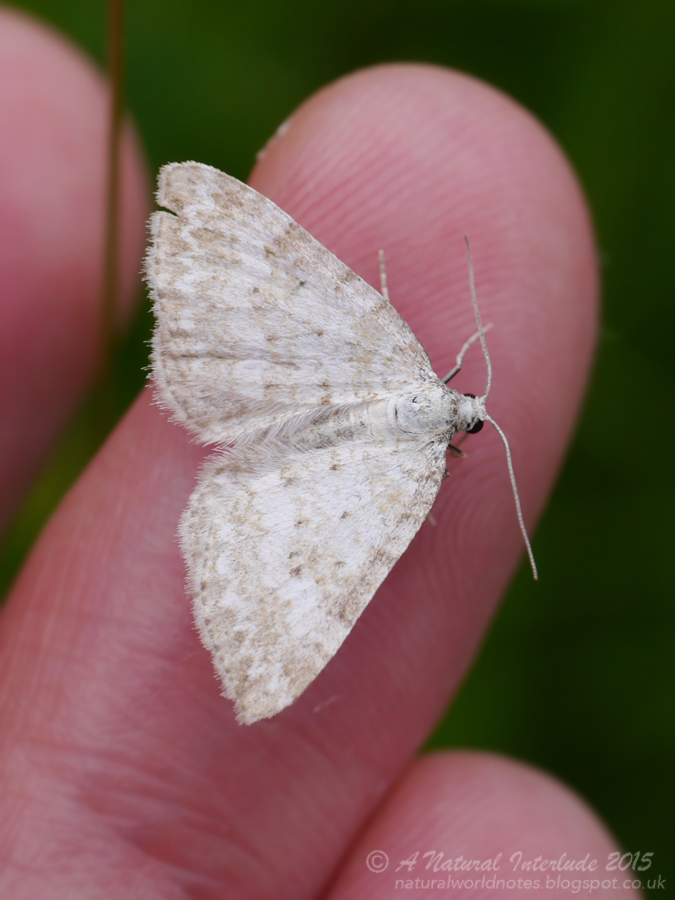
Along with the Small Blue, I also caught up with 2 Grass Rivulet (Perizoma albulata) moths, found at the weekend by another keen local lepidopterist. This is a rarity in the County and I first located the colony at Dellfield meadow last year. It was very encouraging to know that the species is still at home amongst the vast swathes of irresistible Yellow Rattle. A female Small Yellow Underwing (Panemeria tenebrata) moth was ovipositing on Common Mouse-ear. And, a quick check at the NE end of Bovingdon Reach meadow was rewarded with seeing the first flowers on the returning Bee Orchids (Ophrys apifera). All in all, a fantastic morning!
Sunday, 7 June 2015
How small is a Small Blue?!
Well, it is our smallest resident butterfly, with a wingspan that can be as modest as 16mm but averages between 18 and 27mm. Putting that into some kind of perspective, the diameter of a one penny piece is 20mm, so, many a Small Blue (Cupido minimus) could sit comfortably inside the coin’s perimeter. That's small!
Pitstone (Buckinghamshire): On Wednesday last week, it was blustery with only occasional glimpses of sunshine but that didn’t seem to hinder the Small Blues too much. I was essentially hoping to take some photographs with the butterflies settled on my hand/finger so as to convey their size. It was a lot easier than I’d expected. When offered a steady perch, with salts to feed on (i.e. my skin!), the butterflies were content to climb on. When they’d had their fill, they were off to find a more sugary alternative...


The underwing and feeding on salty skin

Before returning to the larval food plant Kidney Vetch (Anthyllis vulneraria)

Pitstone (Buckinghamshire): On Wednesday last week, it was blustery with only occasional glimpses of sunshine but that didn’t seem to hinder the Small Blues too much. I was essentially hoping to take some photographs with the butterflies settled on my hand/finger so as to convey their size. It was a lot easier than I’d expected. When offered a steady perch, with salts to feed on (i.e. my skin!), the butterflies were content to climb on. When they’d had their fill, they were off to find a more sugary alternative...
The underwing and feeding on salty skin
Before returning to the larval food plant Kidney Vetch (Anthyllis vulneraria)
Thursday, 4 June 2015
Life on Germander Speedwell
Mmm….that does sound vaguely like I’m about to regale you with tales of drinking and debauchery onboard a Victorian sailing ship or something! Sadly not. Just moths...
Bovingdon Brickworks (BMT): This week, inspired by moth-er extraordinaire, Ben Sale, I have spent rather too many hours on my knees and elbows with my eyes trained on Germander Speedwell (Veronica chamaedrys). I was, of course, looking for the dinky, day-flying moth Adela (Cauchas) fibulella. Its larval foodplant is G. Speedwell and the adults seem to spend most of their time in or around it. The moth is scarce in Hertfordshire and Ben’s recent find was only the 13th record for the county.
Monday morning was overcast and blustery but I thought it was still worth a moth hunt. I headed to the Brickworks, knowing there was a good supply of G. Speedwell on site. As it turned out, it wasn’t long before I’d found what I thought was Cauchas fibulella. I took some photographs and was really chuffed when Ben later confirmed that I had indeed found another population of this “scarce Hertfordshire moth”. Knowing that I’d got my eye in, I was keen to return and do a proper count of the species.
Today was calm, hot (20°C) and sunny. Perfect conditions, and, searching the 2 main stretches of Germander Speedwell and a couple of larger clumps nearby, I reached a total of 31 Cauchas fibulella! Far more than I had expected. Not only that, but I called in briefly at Westbrook Hay (Hemel BMT) to check another large patch of G. Speedwell and found another 7 there. From these results and discussions with Ben, it may well be that the moth is simply under-recorded rather than scarce but I guess we won’t know that unless we get out and look for it…!
Now that I’ve got the Big Find out of the way, I’ll share a few of the other G. Speedwell critters. There were at least 6 tiny 4mm long, 1mm wide moths, feeding on the nectar. Ben very kindly provided the ID as Glyphipterix simpliciella, a common species of grass moth.
A third moth species dependant on the G. Speedwell is Stenoptilia pterodactyla. I came across what I think is its larva (caterpillar).
Bovingdon Brickworks (BMT): This week, inspired by moth-er extraordinaire, Ben Sale, I have spent rather too many hours on my knees and elbows with my eyes trained on Germander Speedwell (Veronica chamaedrys). I was, of course, looking for the dinky, day-flying moth Adela (Cauchas) fibulella. Its larval foodplant is G. Speedwell and the adults seem to spend most of their time in or around it. The moth is scarce in Hertfordshire and Ben’s recent find was only the 13th record for the county.
Monday morning was overcast and blustery but I thought it was still worth a moth hunt. I headed to the Brickworks, knowing there was a good supply of G. Speedwell on site. As it turned out, it wasn’t long before I’d found what I thought was Cauchas fibulella. I took some photographs and was really chuffed when Ben later confirmed that I had indeed found another population of this “scarce Hertfordshire moth”. Knowing that I’d got my eye in, I was keen to return and do a proper count of the species.
Today was calm, hot (20°C) and sunny. Perfect conditions, and, searching the 2 main stretches of Germander Speedwell and a couple of larger clumps nearby, I reached a total of 31 Cauchas fibulella! Far more than I had expected. Not only that, but I called in briefly at Westbrook Hay (Hemel BMT) to check another large patch of G. Speedwell and found another 7 there. From these results and discussions with Ben, it may well be that the moth is simply under-recorded rather than scarce but I guess we won’t know that unless we get out and look for it…!
 |
| Adela (Cauchas) fibulella on Germander Speedwell |
Now that I’ve got the Big Find out of the way, I’ll share a few of the other G. Speedwell critters. There were at least 6 tiny 4mm long, 1mm wide moths, feeding on the nectar. Ben very kindly provided the ID as Glyphipterix simpliciella, a common species of grass moth.
 |
| Glyphipterix simpliciella on Germander Speedwell |
 |
| Glyphipterix simpliciella on Germander Speedwell |
A third moth species dependant on the G. Speedwell is Stenoptilia pterodactyla. I came across what I think is its larva (caterpillar).
 |
| Stenoptilia pterodactyla on Germander Speedwell |
I was concentrating on moths but there were tiny flies, bees, grasshoppers and beetles all on or around the G. Speedwell. It always amazes me what you find even in just one small 50cm square of a plant like this.
Finally, a bonus find on Monday was what I think is Heath Speedwell (Veronica officinalis). I’d never seen it before and it isn’t included in the Brickworks 2011 Plant Survey. Further correspondence with Martin Parr, Conservation Manager at Maple Lodge, suggests that the plant has previously been recorded in the vicinity of the Brickworks but not actually at the site. So, a new plant to add to the species list as well.
Finally, a bonus find on Monday was what I think is Heath Speedwell (Veronica officinalis). I’d never seen it before and it isn’t included in the Brickworks 2011 Plant Survey. Further correspondence with Martin Parr, Conservation Manager at Maple Lodge, suggests that the plant has previously been recorded in the vicinity of the Brickworks but not actually at the site. So, a new plant to add to the species list as well.
 |
| Heath Speedwell (LEFT); Germander Speedwell (RIGHT) (my thumbnail at the bottom) |
Subscribe to:
Posts (Atom)