Saturday, 27 June 2015

Fancy a Strawberry… & Serenade?

Bovingdon (BMT): I spent a couple of mornings this week looking for Black Horehound (Ballota nigra) and the Horehound Longhorn moth (nemophora fasciella) at the Brickworks (try saying that when you’ve had a tipple or two!). Martin Parr, conservation manager at Maple Lodge, has found this extremely rare Hertfordshire moth at his reserve (details HERE). There are only 2 records of it pre-2006 (thanks Ben for the info), so, it really is a fantastic discovery. I am now very well acquainted with Hedge Woundwort (which sort of looks like Black Horehound) but haven’t found anything vaguely Horehound-y...yet.

Other than that, the Wild Strawberries (Fragaria vesca) were too good to resist this week. I confess, they tasted more like raspberries but perhaps they needed a few more days in the sunshine.

Left: One from the Sainsbury's bush. Right: Four from the Wild Strawberry bush


Three species of butterfly have looked particularly stunning this week. They’re freshly emerged, pristine and energetic: Marbled Whites, Ringlets and Small Tortoiseshell. I end up shaking my head in disbelief that something so perfect is created and destroyed within such a short time frame. The opulence of nature!
(Dave James inspired the shot below when he posted THIS on Twitter - superb photo, Dave!).

Small Tortoiseshell (Aglais urticae)

On Wednesday morning, I came across a male Lesser Whitethroat (Sylvia curruca) serenading me and any old passing female (preferably with feathers and appropriate plumage) at the SW end of the Brickworks. It’s not an easy species to see or find locally, making it all the sweeter to experience. I recorded it’s vocal and hoped that when I returned in the afternoon I might be able to get some video footage. Unfortunately, it had either shut up, or flown off, and it wasn’t there the following morning.


Whilst I’m on the subject of singing birds, it’s been quite interesting to have 2 mixed singing Willow Warblers (Phylloscopus trochilus) on BMT land this Spring. One in the chalk dell at Roughdown and one at the Brickworks. I think both birds are just good mimics, with Chiffchaffs on adjacent territory. I have tried a number of times to record each bird but sod's law applies. Every time I press record, the bird reverts to pure Willow Warbler. Every time I give up and walk away, the bird rattles off a cascading Willow Warbler refrain followed by chiming Chiffchaff notes. Flipping birds. Anyway, I finally managed to get a half decent recording of the mixed singing bird at the Brickworks recently.


Lastly a few nice moths this week: Cinnabar, Burnet Companions, a vibrant Common Purple & Gold (Pyrausta purpuralis) and 2 Triple-stripe Piercers (Grapholita compositella). I watched one Triple-stripe in action. The moth would land on large bramble leaves and then rapidly spin round in a circle, with its head at the centre. It was very odd and I can only assume that this process allowed the moth to pierce the leaf to feed on the juices? The larvae feed on Clover (Trifolium sp), where the eggs are deposited singularly on leaves.

Here's 3 semi-out-of-focus shots in the hope that quantity compensates for quality! Either way, they don't do this little 10mm moth justice. Up close, it's smart!

Triple-stripe Piercer (Grapholita compositella)

Wednesday, 24 June 2015

A Pucker Pair of Pygmy Shrews

Hemel & Bovingdon (BMT): Last week was surprisingly productive....except when it came to blogging. Prepare yourself for an eclectic preamble before we get to the main inspiration for the title. OK, so, I did a few bordering-on-the-obsessive butterfly and moth counts at various BMT sites last week. Once you’ve strolled and counted in one meadow, it is weirdly difficult to resist the urge to stroll and count in another meadow, just to see what else might turn up. Anyway, the best of the butterflies were 2 tired looking Painted Ladies (one at the Brickworks, one at Bovingdon Reach meadow); my first ever Brown Argus at Bovingdon Reach meadow along with a very worn migrant Rush Veneer (Nomophila noctuella) moth. My first Marbled Whites of the year. A few amorous gatherings of Yellow-barred Longhorns (Nemophora degeerella) and my first ever Hummingbird Hawk-moth (Macroglossum stellatarum) at the Brickworks, which was superb. I chased it around the Birds-foot Trefoil, but it didn’t stop for a photo op.

This time of year is wonderful for finding bundles of baby birds, often just fledged. I came across a group of at least 6, probably 8, tiny, newly fledged Wrens, still sporting their yellow gapes, in Hay Wood on Wednesday. The light was terrible unfortunately so no decent photos. On Thursday, it was Nuthatches at the Brickworks. Again, there could have been up to 8 little ones, all together, moving noisily through the trees. The head markings on the young aren’t so well developed so they can look a bit scruffy but still very sweet.

On the flora front, I counted the Bee Orchids (Ophrys apifera) on Bovingdon Reach meadow. It’s not the easiest of tasks. One wrong move and you’ve crushed rather than counted the specimen! Anyway, I got up to 87 spikes, no casaulties, and there’s bound to be ones that I’ve missed, so, roughly 100 or so plants which is fantastic.

Finally, in the gloom and drizzle on Saturday, I came across a wonderful stretch of Wild Strawberries (Fragaria vesca) at the Brickworks. It’s not a species listed on the 2011 plant survey so must be a fairly recent colonisation. I don’t think I’ve ever seen so many plants all in one place - it really was a Summery, cheerful sight. And, on the fauna front, I picked up a couple of dead Shrews, both on the path but at different locations.

OK, to the Shrews!


....after doing a fair bit of reading and hearing from a couple of well informed, experienced and licensed mammal handlers, it turns out the two I picked up on Saturday were Pygmy Shrews (Sorex minutus).

From my limited experience, it’s not actually that easy to separate Common and Pygmy Shrews, especially if you happen to find a large Pygmy or small Common with a tail that is close to the tolerances of either species. However, the guideline features seem to be as follows and, considering the 'the sum of the parts', it is possible to tease out the correct ID:

Common Shrew (Sorex araneus)
Pygmy Shrew (Sorex minutus)
Body length48-80mm40-65mm (but could be up to 72mm)*
Tail length24-44mm32-46mm
Tail length relative to body lengthusually 50%usually 65-70+%
TeethRed tippedRed tipped
Tail featuresYoung have furry tails, adults have a few stiff hairs underneath and bald on topProportionally longer, thicker and hairier than the other shrew species
Fur colourTri-coloured (dark brown back, paler sides and grey/white underside)Two-tone (brown back, pale underside)
ActiveMainly nocturnalDay and night

[*A mammal expert on ISPOT provided some very helpful information, noting that the head-body range given for Pygmy Shrews in field guides is 4-6.5cm in one (UK) and 4-7.2cm in another (Europe and Middle East). Interestingly, the latter book noted that size increases from north to south and from east to west, and Britain is at the western end of this shrew's range.]

The two Pygmy Shrews (Sorex minutes) I found were actually identical in their measurements:
  • Body = 65mm
  • Tail = 40mm
  • Tail relative to body = 61%

As with the Common Shrew in April, unless you have a license to trap and handle live mammals, it's rare you get to see these creatures up close, especially when they are in good condition. One of the two I picked was as fresh as the proverbial daisy (except for being dead, of course!).


Two-tone coat, with fairly clear demarcation between brown upper and pale underside


Back foot (underside)

Back foot (side view)

Front foot (upperside)

Front foot (underside)

Red-tipped teeth and pointed nose

For more info on Pygmy Shrews, see THIS great article. It includes such facts as individuals needing to eat 1.25x their body weight in food per day in order to survive. And, they can die of starvation if they’re not able to feed for a couple of hours. It’s not surprising it’s a species with a maximum lifespan of 13 months!

Monday, 22 June 2015

Greater Yellowlegs at Titchfield Haven

The von Trapp’s suggest the beginning is a very good place to start. I’m going to be deliberately contrary and begin at the end of last week, with a visit to Titchfield Haven on Sunday. I may well be one of the last birders in the south east, if not the last, to head to the Greater Yellowlegs (Tringa melanoleuca) on the south coast. It’s been there all year, found in the middle of January.

We arrived at the reserve late morning and made our way to the Suffern hide, overlooking the River Meon. The lanky, Yankee wader was some way off to the left, mixing with the Black-tailed Godwits. Not quite the boreal forest regions of Canada or Alaska, where this beauty should have been off making baby Yellowlegs! Still, here it was, and it wasn’t long before it moved right and closer, constantly sifting the water and probing for food. It rarely stood still! Ultimately, we had great scope views and when it eventually flew up, off and far right with the group of Godwits, it made for a natural end to the experience.

A few digiscoped photos (Swaro ATS80HD, DCB-A, Panasonic G3, 20mm f1.7. I forgot my remote shutter release, unfortunately. Distance to bird: approx 80-100 metres)


Catching a fish & showing its rump!


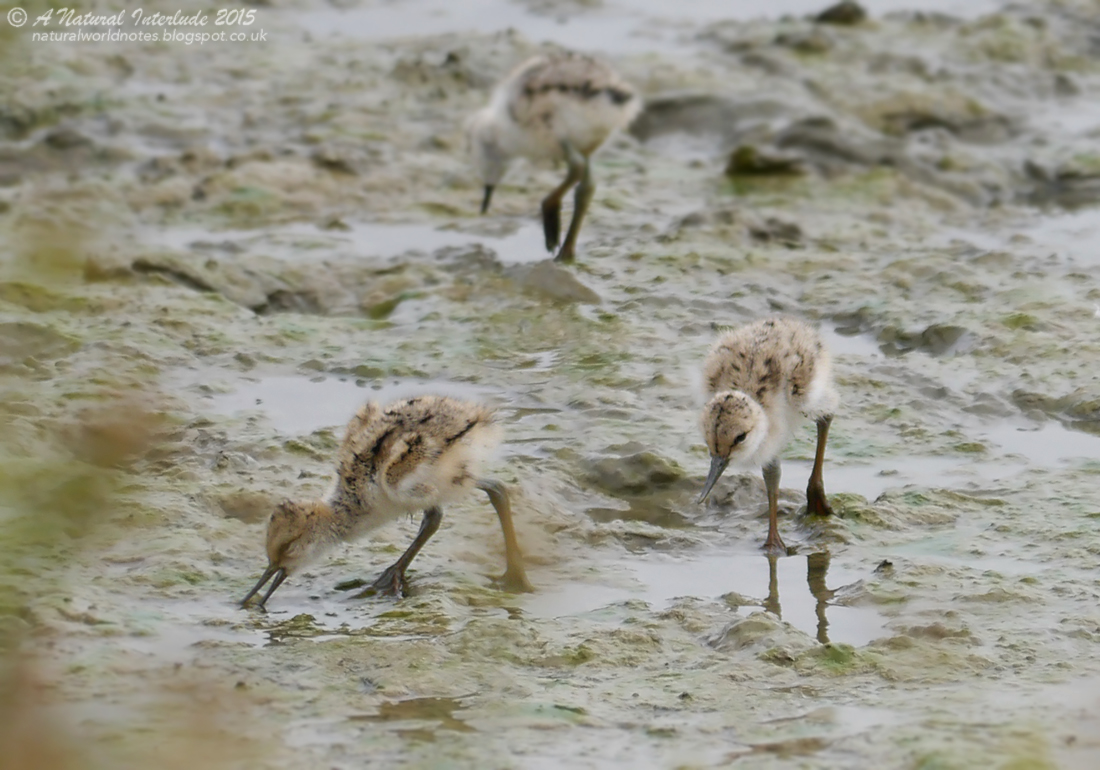
We checked out the Meadow hide but there wasn’t much of interest there. From the Meon Shore hide, there were plenty of boisterous Black-headed Gulls, a few Oystercatchers and Avocets at various stages of development. From the Spurgin hide, we had lovely close views of an Avocet family, with at least 6 very young juveniles scurrying this way and that. I managed to catch 3 in the same frame...


By about 2:30pm, I’d run out of steam so we called it a day and headed back to Herts. Really pleased to add another beautiful bird to my life list.

Sunday, 14 June 2015

Creatures of the Night

Hemel (BMT): I have been out roaming the woods in the dead of night! Last Thursday, I joined the Box Moor Trust mothing team up at Roughdown Common. My mothing prowess has barely moved beyond its infancy but Ben, David and Roger are a friendly and forgiving crew and equally generous in sharing their knowledge with a novice. The trap lights went on at about 9:45pm and the wait began. It was a slow start. I think the first moth in the trap was a Common Pug (Eupithecia vulgata). And, it wasn’t until about 10:30pm that the moths really began to come in with the arrival of a beautiful Green Silver-lines (Pseudoips prasinana). 20 minutes later, an exquisite Coronet (Craniophora ligustri) turned up, followed closely by the bright and incredible Small Elephant Hawk-moth (Deilephila porcellus). I have been searching, without success, the Rosebay Willowherb (Chamerion angustifolium) at Bovingdon Brickworks for the last couple of years, hoping to find an Elephant Hawk-moth (Deilephila elpenor) or caterpillar there. To see its less common relative up close was fantastic. The colours and shapes and details on this moth are extraordinary.

Small Elephant Hawk-moth (Deilephila porcellus)


Whilst I faffed about trying to photograph the Small Elephant Hawk-moth....in the dark...one-handed...with a bog standard in-camera flash…the rest of the team were feverishly counting and identifying the quickening arrivals. I eventually tore myself away from the mesmerising pink elephant(!) and also photographed a Pale Tussock (Calliteara pudibunda), Iron Prominent (Notodonta dromedarius) and Angle Shades (Phlogophora meticulosa). I’m a sucker for the pretty ones.

By 11:30pm, I reluctantly had to call it a night and left the team to it. They didn’t pack up until 2am and, by all accounts, that’s when it really started to get busy! The full catch report, with a few more fascinating photos, is on Ben’s expert blog HERE.

Pale Tussock (Calliteara pudibunda)

Iron Prominent (Notodonta dromedarius)

Green Silver-lines (Pseudoips prasinana)

Angle Shades (Phlogophora meticulosa)

Coronet (Craniophora ligustri)
Flash-photography really doesn't do this moth justice. The whites were all in fact a shimmering rich silver.
The wings were covered in an assortment of textures and ripples, beautifully patterned. 

The following day, Ben let me know that amongst the catch, after I left, they’d retrieved a Buff-tip (Phalera bucephala). This is one I have been really keen to see after finding the larvae (caterpillars) at the site last Autumn. When settled, this clever little moth hides in plain sight, easily mistaken for the broken twig of a Silver Birch tree. Anyway, they’d potted it up for me and I was able to finally see this marvel of nature at close quarters. The buff marking at the head end and on the wing tips even includes mimicry for the thickness of the bark and the striations of the wood flesh. Jaw-droppingly ingenious.

As it turned out, it was a female and she'd laid some eggs in the specimen pot unfortunately (the irony wasn't lost on me. The specimen left a specimen!).

Buff-tip (Phalera bucephala) moth eggs

I returned to Roughdown early evening, found a suitable perch and settled Mrs Buff-tip safely back. Hopefully she’ll lay her eggs in a more nutritious location next time!

Buff-tip (Phalera bucephala)

Buff-tip (Phalera bucephala)

Buff-tip (Phalera bucephala)

A big thank you to Ben, David and Roger for sharing these creatures of the night with me. They are truly fascinating!